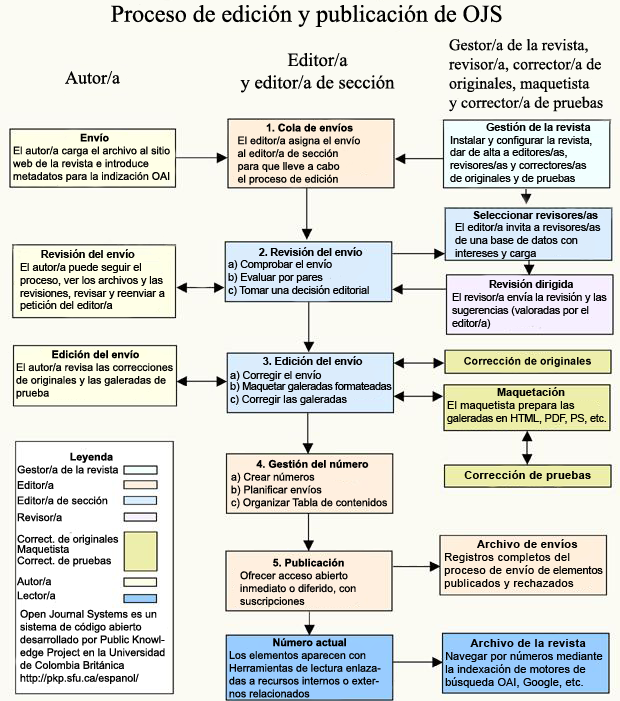
Proceso de publicación
General Approach to the Editorial Process
Revista Colombiana de Ciencias Administrativas (RCCA) employs a rigorous, transparent, and structured editorial process aimed at ensuring the scientific quality, disciplinary relevance, and academic integrity of the manuscripts received.
All submitted articles undergo a double-blind peer review process, guaranteeing the confidentiality of authors and reviewers, as well as impartiality in editorial decision-making.
Stages of the Editorial Process
The editorial process unfolds through the following stages:
Manuscript Submission
The author submits their manuscript through the journal's OJS platform, ensuring compliance with the editorial standards and author guidelines.
Preliminary Editorial Review
The editorial team conducts an initial evaluation to verify:
- Thematic relevance to the journal's focus
- Compliance with submission guidelines
- Originality of the manuscript using similarity detection tools
- Basic methodological coherence
At this stage, the manuscript may be:
- Accepted for peer review
- Returned for revisions
- Rejected
Assignment to Peer Review
Manuscripts that pass the preliminary review are sent to at least two (2) external reviewers, experts in the article's subject area.
The evaluation is conducted using a double-blind review process, preserving the anonymity of both the authors and the reviewers.
Peer Review
Reviewers analyze the manuscript based on criteria such as:
- Originality and contribution to the field
- Methodological rigor
- Argumentative coherence
- Disciplinary relevance
- Quality of academic writing
- Appropriate use of sources and images
Each reviewer issues a report, which may be:
- Accept
- Accept with modifications
- Reject
Editorial Decision
Based on the reviewers' reports, the editorial team makes a final decision:
- Acceptance of the manuscript
- Request for revisions
- Rejection
In case of disagreement among reviewers, a third reviewer may be consulted.
Authors' Corrections
When the manuscript requires adjustments, the authors must submit a revised version along with a detailed response to the reviewers' comments.
Editing and Publication
Once accepted, the manuscript undergoes the following processes:
- Copyediting
- Layout
- Markup (according to publication standards)
Finally, the article is published on the journal's platform with its respective digital identifier (DOI).
Editorial Process Timeline
The estimated editorial process timeline is:
- Preliminary review: 1 to 2 weeks
- Peer review: 4 to 6 weeks
- Editorial decision: 2 weeks
- Editing and publication process: 2 to 4 weeks
Timelines may vary depending on the nature of the manuscript and reviewer availability.
Evaluation Criteria
Manuscripts are evaluated based on:
- Methodological rigor
- Applicability
- Contribution to the field of administration
- Appropriate use of data
Confidentiality and Ethics of the Process
The editorial process guarantees:
- Confidentiality of manuscripts
- Anonymity in the evaluation process
- Transparency in decision-making
- Compliance with the journal's ethical policy
All participants in the process (authors, reviewers, and editors) must adhere to the ethical principles established by the journal.
Traceability of the Editorial Process
The journal manages its editorial process through the OJS platform, which allows for:
- Recording of all stages of the process
- History of editorial decisions
- Tracking of reviews
- Formal communication with authors and reviewers
This ensures the traceability and transparency of the evaluation and publication process.
Formats associated with the process
To preserve the quality, suitability and transparency of the publication process, the use of the following format (or the one provided through the OJS platform) is foreseen:
Editorial project evaluation - Peer evaluator